







Space 2.0
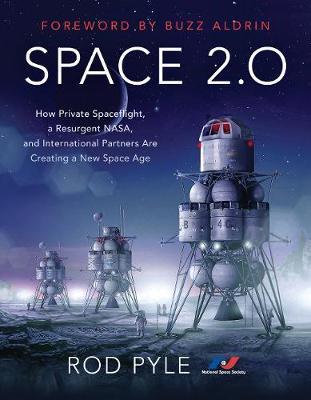
Space 2.0
We're on the cusp of new era in the great adventure of space exploration.
More than a half-century ago, humanity first hurled objects into space, and almost 50 years ago, astronauts first walked on the moon. Since then, we have explored Earth's orbit with shuttles, capsules, and space stations; sent robots to Mars, Venus, Mercury, Jupiter, Saturn, and Uranus; sampled a comet; sent telescopes into orbit; and charted most of our own planet.
What does the future hold?
In Space 2.0, space historian Rod Pyle, in collaboration with the National Space Society, will give you an inside look at the next few decades of spaceflight and long-term plans for exploration, utilization, and settlement.
No longer the exclusive domain of government entities such as NASA and other national agencies, space exploration is rapidly becoming privatized, with entrepreneurial startups building huge rocket boosters, satellites, rocket engines, asteroid probes, prospecting craft, and even commercial lunar cargo landers to open this new frontier. Research into ever more sophisticated propulsion and life support systems will soon enable the journey to Mars and destinations deeper in our solar system. As these technologies continue to move forward, there are virtually no limits to human spaceflight and robotic exploration.
Citește mai mult
More than a half-century ago, humanity first hurled objects into space, and almost 50 years ago, astronauts first walked on the moon. Since then, we have explored Earth's orbit with shuttles, capsules, and space stations; sent robots to Mars, Venus, Mercury, Jupiter, Saturn, and Uranus; sampled a comet; sent telescopes into orbit; and charted most of our own planet.
What does the future hold?
In Space 2.0, space historian Rod Pyle, in collaboration with the National Space Society, will give you an inside look at the next few decades of spaceflight and long-term plans for exploration, utilization, and settlement.
No longer the exclusive domain of government entities such as NASA and other national agencies, space exploration is rapidly becoming privatized, with entrepreneurial startups building huge rocket boosters, satellites, rocket engines, asteroid probes, prospecting craft, and even commercial lunar cargo landers to open this new frontier. Research into ever more sophisticated propulsion and life support systems will soon enable the journey to Mars and destinations deeper in our solar system. As these technologies continue to move forward, there are virtually no limits to human spaceflight and robotic exploration.
PRP: 108.66 Lei
Acesta este Prețul Recomandat de Producător. Prețul de vânzare al produsului este afișat mai jos.
97.79Lei
97.79Lei
108.66 LeiPrimești 97 puncte
Indisponibil
Descrierea produsului
We're on the cusp of new era in the great adventure of space exploration.
More than a half-century ago, humanity first hurled objects into space, and almost 50 years ago, astronauts first walked on the moon. Since then, we have explored Earth's orbit with shuttles, capsules, and space stations; sent robots to Mars, Venus, Mercury, Jupiter, Saturn, and Uranus; sampled a comet; sent telescopes into orbit; and charted most of our own planet.
What does the future hold?
In Space 2.0, space historian Rod Pyle, in collaboration with the National Space Society, will give you an inside look at the next few decades of spaceflight and long-term plans for exploration, utilization, and settlement.
No longer the exclusive domain of government entities such as NASA and other national agencies, space exploration is rapidly becoming privatized, with entrepreneurial startups building huge rocket boosters, satellites, rocket engines, asteroid probes, prospecting craft, and even commercial lunar cargo landers to open this new frontier. Research into ever more sophisticated propulsion and life support systems will soon enable the journey to Mars and destinations deeper in our solar system. As these technologies continue to move forward, there are virtually no limits to human spaceflight and robotic exploration.
Citește mai mult
More than a half-century ago, humanity first hurled objects into space, and almost 50 years ago, astronauts first walked on the moon. Since then, we have explored Earth's orbit with shuttles, capsules, and space stations; sent robots to Mars, Venus, Mercury, Jupiter, Saturn, and Uranus; sampled a comet; sent telescopes into orbit; and charted most of our own planet.
What does the future hold?
In Space 2.0, space historian Rod Pyle, in collaboration with the National Space Society, will give you an inside look at the next few decades of spaceflight and long-term plans for exploration, utilization, and settlement.
No longer the exclusive domain of government entities such as NASA and other national agencies, space exploration is rapidly becoming privatized, with entrepreneurial startups building huge rocket boosters, satellites, rocket engines, asteroid probes, prospecting craft, and even commercial lunar cargo landers to open this new frontier. Research into ever more sophisticated propulsion and life support systems will soon enable the journey to Mars and destinations deeper in our solar system. As these technologies continue to move forward, there are virtually no limits to human spaceflight and robotic exploration.
Detaliile produsului
De același autor



Istoricul tău de navigare
Acum se comandă
Noi suntem despre cărți, și la fel este și
Newsletter-ul nostru.
Abonează-te la veștile literare și primești un cupon de -10% pentru viitoarea ta comandă!
*Reducerea aplicată prin cupon nu se cumulează, ci se aplică reducerea cea mai mare.
