







Origamics: Mathematical Explorations Through Paper Folding
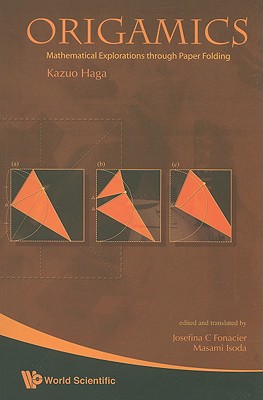
Origamics: Mathematical Explorations Through Paper Folding
The art of origami, or paper folding, is carried out using a square piece of paper to obtain attractive figures of animals, flowers or other familiar figures. It is easy to see that origami has links with geometry. Creases and edges represent lines, intersecting creases and edges make angles, while the intersections themselves represent points. Because of its manipulative and experiential nature, origami could become an effective context for the learning and teaching of geometry.In this unique and original book, origami is an object of mathematical exploration. The activities in this book differ from ordinary origami in that no figures of objects result. Rather, they lead the reader to study the effects of the folding and seek patterns. The experimental approach that characterizes much of science activity can be recognized throughout the book, as the manipulative nature of origami allows much experimenting, comparing, visualizing, discovering and conjecturing.The reader is encouraged to fill in all the proofs, for his/her own satisfaction and for the sake of mathematical completeness. Thus, this book provides a useful, alternative approach for reinforcing and applying the theorems of high school mathematics.
PRP: 399.90 Lei
Acesta este Prețul Recomandat de Producător. Prețul de vânzare al produsului este afișat mai jos.
359.91Lei
359.91Lei
399.90 LeiPrimești 359 puncte
Indisponibil
Descrierea produsului
The art of origami, or paper folding, is carried out using a square piece of paper to obtain attractive figures of animals, flowers or other familiar figures. It is easy to see that origami has links with geometry. Creases and edges represent lines, intersecting creases and edges make angles, while the intersections themselves represent points. Because of its manipulative and experiential nature, origami could become an effective context for the learning and teaching of geometry.In this unique and original book, origami is an object of mathematical exploration. The activities in this book differ from ordinary origami in that no figures of objects result. Rather, they lead the reader to study the effects of the folding and seek patterns. The experimental approach that characterizes much of science activity can be recognized throughout the book, as the manipulative nature of origami allows much experimenting, comparing, visualizing, discovering and conjecturing.The reader is encouraged to fill in all the proofs, for his/her own satisfaction and for the sake of mathematical completeness. Thus, this book provides a useful, alternative approach for reinforcing and applying the theorems of high school mathematics.
Detaliile produsului



