





Fault-Tracing: Against Quine-Duhem
Fault-Tracing: Against Quine-Duhem
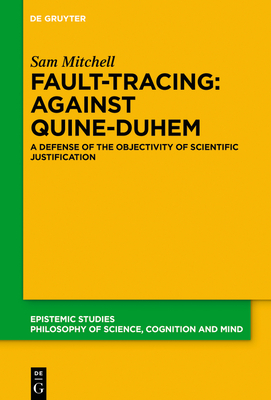
It is widely believed in philosophy of science that nobody can claim that any verdict of science is forced upon us by the effects of a physical world upon our sense organs and instruments. The Quine-Duhem problem supposedly allows us to resist any conclusion. Views on language aside, Quine is supposed to have shown this decisively. But it is just false. In many scientific examples, there is simply no room to doubt that a particular hypothesis is responsible for a refutation or established by the observations. Fault Tracing shows how to play independently established hypotheses against each other to determine whether an arbitrary hypothesis needs to be altered in the light of (apparently) refuting evidence. It analyses real examples from natural science, as well as simpler cases. It argues that, when scientific theories have a structure that prevents them from using this method, the theory looks wrong, and is subject to serious criticism. This is a new, and potentially far-reaching, theory of empirical justification.
201.42Lei
201.42Lei
Primesti 201 puncte
Indisponibil
Descrierea produsului
It is widely believed in philosophy of science that nobody can claim that any verdict of science is forced upon us by the effects of a physical world upon our sense organs and instruments. The Quine-Duhem problem supposedly allows us to resist any conclusion. Views on language aside, Quine is supposed to have shown this decisively. But it is just false. In many scientific examples, there is simply no room to doubt that a particular hypothesis is responsible for a refutation or established by the observations. Fault Tracing shows how to play independently established hypotheses against each other to determine whether an arbitrary hypothesis needs to be altered in the light of (apparently) refuting evidence. It analyses real examples from natural science, as well as simpler cases. It argues that, when scientific theories have a structure that prevents them from using this method, the theory looks wrong, and is subject to serious criticism. This is a new, and potentially far-reaching, theory of empirical justification.
Detaliile produsului



